
Service comparison
Detection, monitoring, and active guarding each serve a distinct role.
Each layer has a different purpose. The strongest strategy coordinates the appropriate layers around the property’s operating risks and response expectations.
Compare the layers
What each service is designed to do.
Availability, features, response procedures, and supported integrations depend on the selected platform, property, service plan, and approved operating protocol.
| Service | Primary purpose | Typical components | Best suited for |
|---|---|---|---|
| Early Detection Systems | Identifies developing activity or conditions sooner | Analytics, thermal devices, perimeter sensors, detection rules | Properties that need earlier warning before a threat reaches a critical area |
| Live Monitoring & Remote Site Surveillance | Maintains scheduled or continuous remote awareness | Supported alarms, video events, remote connectivity, operator review | After-hours, unattended, distributed, temporary, or high-risk sites |
| Virtual Security Guard & Real-Time Incident Response | Adds active remote patrol, verification, intervention, and coordinated escalation | Live operators, camera views, analytics, PA talk-down, contact and dispatch protocols, reporting | Sites that need a visible remote security presence and a documented path from detection to action |
Frequently asked questions
How the services work together.
A professional assessment determines which capabilities are appropriate, which systems can integrate, and what response workflow is practical.
Does live monitoring automatically include audio talk-down?
No. Audio intervention requires compatible field speakers or audio devices, suitable connectivity, an approved monitoring service, and documented authorization and response procedures.
Is a virtual security guard the same as an on-site guard?
No. Our combined virtual security guard and incident response service uses supported cameras, analytics, live operators, audio tools, and escalation procedures. It does not replace every function an on-site security officer may perform.
Can early detection work without 24/7 monitoring?
Some systems can notify designated users directly, while others can connect to monitoring or response services. The appropriate workflow depends on the risk, schedule, technology, and people available to respond.
Can these services use an existing camera or alarm system?
Possibly. We review platform compatibility, remote-access security, coverage, recording, network capacity, device health, and operator requirements before recommending reuse or upgrades.
What is established before service activation?
Coverage schedules, priority events, authorized contacts, verification rules, talk-down guidance, dispatch instructions, exception handling, and reporting expectations should be documented and tested.
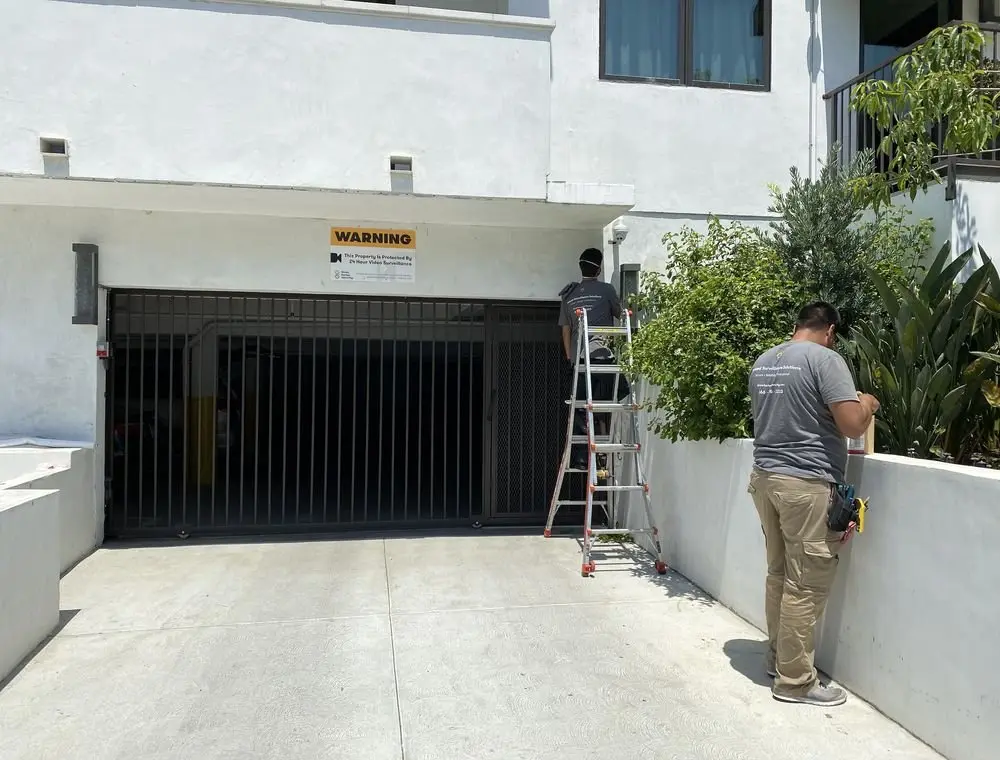 Fieldwork inLos Angeles
Authentic Three Factor Security field work
Practical guidance informed by real project conditions.
Our planning resources reflect the questions, constraints, and decisions that appear during site reviews, installation, commissioning, handoff, maintenance, and system expansion.
View more project experienceBegin with a professional assessment