Choose how security events move from detection to a real response.
Monitoring is not one universal service. The right arrangement depends on the system, property, event types, coverage schedule, camera eligibility, communications, contacts, dispatch instructions, and the people responsible for the site.
The exact steps depend on the installed systems and signed service agreement. This framework makes the intended workflow clear before activation.
01
Detection
A supported camera, analytic, alarm, access event, or other enrolled input identifies activity under the configured conditions.
02
Verification
The event is reviewed through the selected workflow to distinguish supported activity from routine movement or a false alarm.
03
Deterrence
Where included and supported, live audio, a siren, lighting, or a prerecorded message may be used to discourage unwanted activity.
04
Response
Defined contacts, private security, emergency services, or another approved escalation path may be coordinated according to the agreement.
05
Notification
Authorized users receive the applicable alert, event information, operator action, or incident record through the selected system and service.
Monitoring approaches
From customer-managed alerts to live event intervention.
Every monitoring arrangement is customized. System type, property conditions, eligible devices, coverage schedule, response expectations, and service terms are reviewed before a private recommendation is provided.
01
Customer-managed
Self-Managed Alerts
Properties where authorized users prefer to receive system notifications and manage review and response directly.
Notifications delivered through supported systems
Review and response remain customer-directed
Available functions depend on the selected platform
Final system capabilities are confirmed during design
02
Professionally supported
Professional Event Monitoring
Properties that benefit from a defined monitoring and escalation process for supported security events.
Supported events follow an agreed monitoring workflow
Authorized contacts and response paths are documented
Coverage is configured around the property and system
Availability and final service terms are confirmed in writing
03
Property-specific
Live Video Monitoring & Intervention
Properties where selected video events may require live review, verification, and an approved intervention or escalation path.
Selected cameras and events may be enrolled where appropriate
Monitoring schedules and operator actions are customized
Supported deterrence and escalation depend on the installed system
Eligibility and scope are established after assessment
Monitoring account readiness
Keep the people, schedules, and instructions as current as the equipment.
Strong monitoring depends on an accurate operating plan. A recurring review reduces avoidable confusion by confirming who receives an event, when the property is protected, what information is available, and how the selected response should proceed.
01
Emergency contact order
Confirm current names, phone numbers, email addresses, decision authority, call order, and account-recovery contacts after staffing, ownership, tenant, or management changes.
02
Hours & arming schedules
Review operating hours, holiday schedules, automatic arming, opening and closing exceptions, temporary access, and who is responsible when the property remains open late.
03
Event coverage
Verify the enrolled alarm zones, cameras, analytic areas, service hours, notification rules, privacy limits, and the routine activity that should not trigger a response.
04
Verification & escalation
Document the available information, approved operator actions, property contacts, audio use where supported, private-security coordination, and emergency-service request path.
05
Communication & power
Confirm the primary and supported backup communication paths, panel or device power, battery condition, relevant network equipment, and the expected behavior during an outage.
06
Recurring function check
Use the correct provider procedure to test representative events, notifications, playback, timestamps, and evidence export after changes and on the schedule appropriate for the installed system.
Exact testing steps, monitoring actions, response availability, communication paths, and review frequency depend on the installed equipment, provider procedures, property conditions, and written service agreement.
Monitoring boundaries
Who can see what—and when—must be documented.
Monitoring does not mean unrestricted access to every camera. The enrolled devices, service hours, supported events, operator actions, authorized contacts, customer permissions, and retention are established through the selected platform and monitoring agreement.
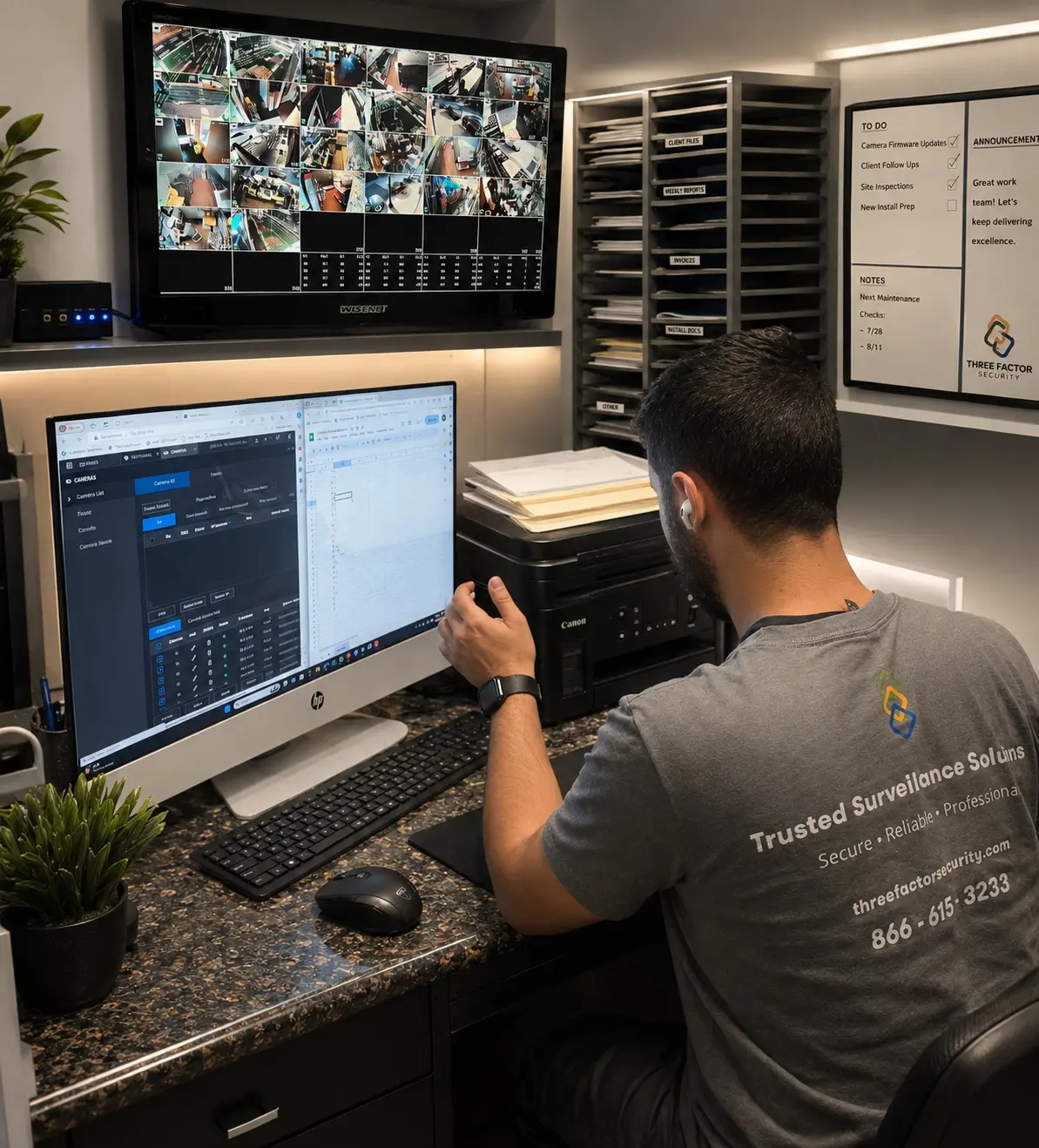
Fieldwork inBaldwin ParkSystem configuration, live-view review, documentation, and verification
Authentic Three Factor Security field work
Monitoring begins with correct configuration and verified views.
Camera views, event settings, notifications, users, schedules, and response expectations must be coordinated before a monitored workflow can support the property effectively.
Professional monitoring is provided through independent monitoring providers. Three Factor Security installs and configures the supported technology and coordinates the agreed service scope. Enrolled events, service hours, verification, talk-down, notifications and dispatch coordination depend on the selected platform and written monitoring agreement. Self-monitored options rely on the customer receiving and acting on alerts.