Purpose before placement
Each view should support a defined security or operating purpose while respecting neighboring property, private areas, residents, guests, employees, and applicable rules.

Security without unnecessary access
A professional security design should define why video is collected, where it is recorded, how long it is retained, who can see it, when a monitoring provider may access an enrolled event, and how permissions change over time.
Privacy by project design
Available privacy, encryption, audit, masking, retention, and access features vary by manufacturer, platform, monitoring provider, licensing, configuration, and service agreement.
Each view should support a defined security or operating purpose while respecting neighboring property, private areas, residents, guests, employees, and applicable rules.
Named customer administrators decide who receives supported app, desktop, playback, export, credential, or configuration access within the selected platform.
Local, cloud, or hybrid recording, expected retention, redundancy, exports, and internet-dependency are confirmed for the actual system—not assumed from a camera count.
Enrolled cameras, supported events, service hours, operator permissions, actions, contacts, and retention are established through the monitoring platform and signed agreement.
Strong unique credentials, multifactor authentication where supported, least-privilege roles, controlled sharing, timely updates, and prompt user removal reduce avoidable exposure.
Administrators, permissions, shared links, integrations, recording health, exports, service access, and decommissioning should be reviewed as people and properties change.
Recording architecture
Supported NVR, DVR, server, appliance, or edge storage can preserve recording on the property and may reduce dependence on continuous internet service. Hardware security, drive health, backups, physical access, and remote connectivity still require planning.
Cloud-managed recording or archiving may simplify remote access, selected off-site retention, updates, and multi-site administration. Bandwidth, recurring fees, account security, provider retention, export workflows, and service continuity should be confirmed.
A hybrid design may combine local continuity with selected cloud access or archiving. Compatibility, duplicate retention expectations, upload capacity, event selection, permissions, and recovery procedures must be documented.
Access boundaries
The exact roles depend on the selected systems. The table shows a useful least-privilege starting point for project planning.
| Role | Typical supported access | Recommended boundary |
|---|---|---|
| Owner / primary administrator | System administration, users, permissions, settings, live and recorded video, exports | Limit the number of full administrators and protect accounts with the strongest available controls |
| Board or property manager | Selected sites, cameras, doors, events, reports, exports, and user administration | Separate board, management, resident, vendor, and security responsibilities |
| Employee, resident or household user | Daily controls, selected cameras or doors, notifications, arming, or credentials | Provide only the locations and actions needed for the person’s role |
| Installer or service professional | Time-limited configuration or diagnostic access when required | Authorize access for a defined service purpose and remove or reduce it after completion |
| Monitoring operator | Only enrolled events, cameras, audio, signals, and actions supported by the monitoring plan | Document service hours, triggers, operator actions, contacts, escalation, and retention in the agreement |
License-plate recognition
Plate capture should be planned with a legitimate property objective, dedicated lane geometry, wider vehicle context, named users, documented retention, controlled searches and sharing, representative testing, and a clear review process.
Legal, workplace & community requirements
Three Factor Security can help document technical capabilities and the intended system workflow. Property owners and operators remain responsible for obtaining appropriate legal, insurance, HR, privacy, policy, consent, notice, permit, and jurisdictional guidance for their use of the system.
 Fieldwork inBaldwin Park
Authentic Three Factor Security field work
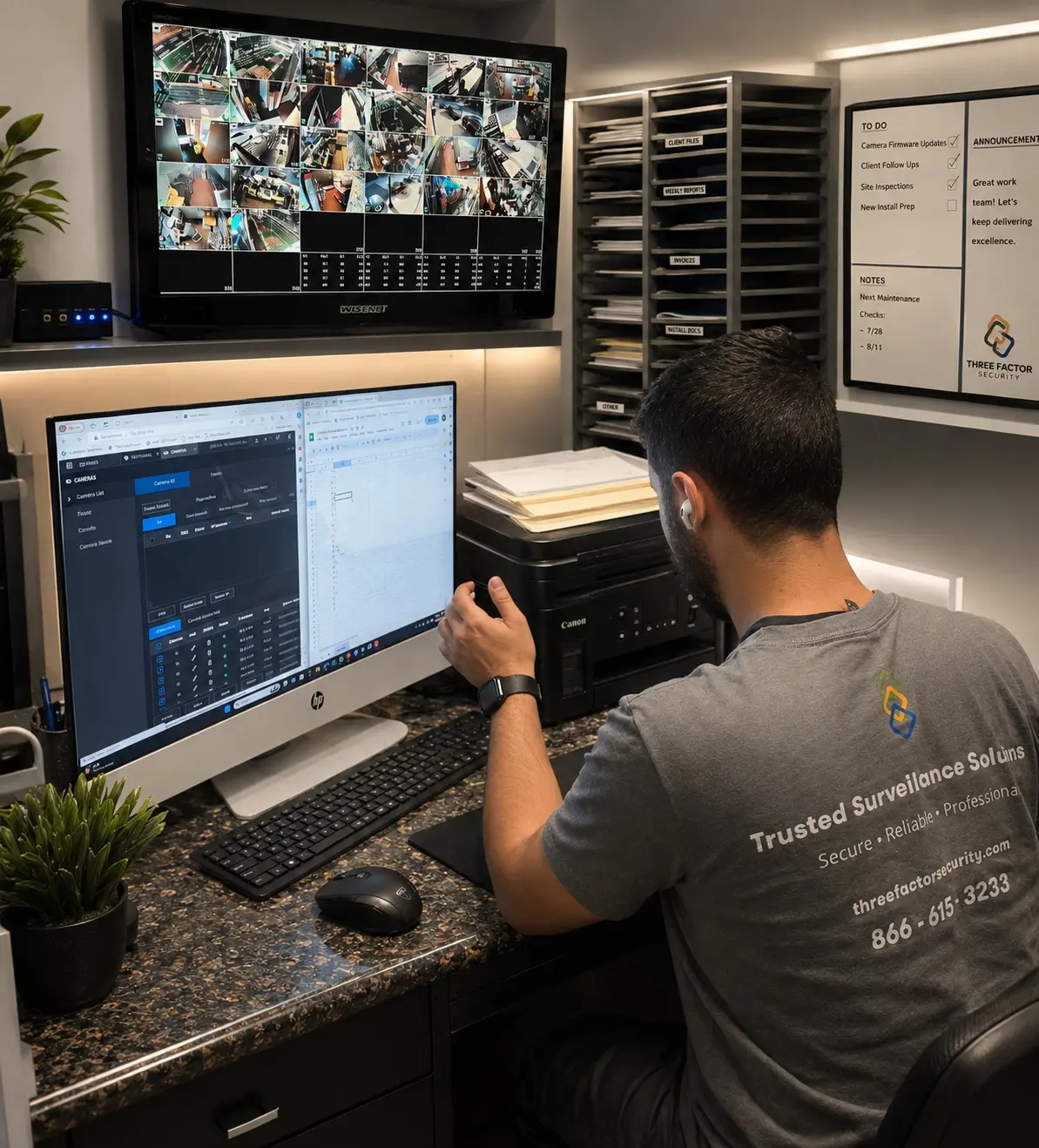
Permissions, retention, export access, notifications, and camera views are reviewed as part of a responsible system setup and documented handoff.
View more project experienceBegin with a professional assessment